Before the Printed Programme: How Concert Notes Prepare the Ear
Trace how printed concert programmes changed access to performance information, and see how they differ from spoken introductions and informal guidance.
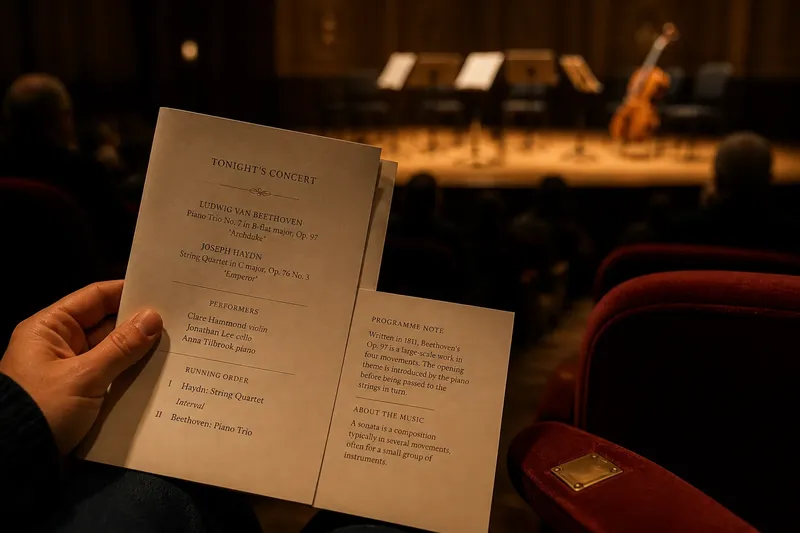
At a concert, a printed programme lets you check a composer’s name while you wait for the musicians to take their places. The story of printed concert programmes is not a simple shift from speech to paper: spoken introductions, printed material and informal knowledge can coexist, and their use has varied between events and venues.
Spoken context belonged to the occasion
Before an audience could consult a programme, it could still receive information in other ways. A performer or host might introduce a piece, while listeners might arrive with knowledge from lessons, earlier performances or conversation. The exact practice depended on the event; it is safer to describe these as possible sources of context than as a universal pattern.
A spoken introduction reaches listeners together and can clarify a name or point out who is playing. But it passes in the moment. Anyone who misses a detail may not have an easy way to revisit it, and an informal explanation depends on having someone nearby who can provide one.
Printed programmes made information available to revisit
A printed programme puts information in the listener’s hands rather than delivering it only at a particular moment. A reader can consult it before the performance, return to it during a break or look at it afterwards. That change concerns access and timing, not a complete replacement of spoken introductions.
Programmes can contain practical listings as well as musical notes: titles, composers, performers and, depending on the event, background or descriptions of the works. Their contents and level of detail differ. Without a particular programme or a documented account, it is unwise to claim that all programmes developed in the same way or that one format displaced another at a set point in history.
The useful distinction is between information delivered aloud and information available on the page. Speech can be brief and shared; print can be revisited privately. Neither form tells the listener what to value, and either may be absent or supplemented by the other.
Printed notes serve a different purpose from a live introduction
A short introduction can identify a work or offer a few words of context without asking the audience to read. Printed notes can provide more room for names, terminology or background, but they also ask the reader to decide when to engage with the page. These are different strengths, rather than stages in a single inevitable progression.
For a listener, the distinction can matter more than the history. If an introduction has already explained a piece, the programme may still be useful for checking the performers or revisiting a term. If there is no spoken introduction, the printed page can supply some orientation, though it need not explain everything.
What can a printed programme tell you?
- Work title: Check the title if you want to distinguish the listed piece from another work with a similar name; if it is unfamiliar, use the composer’s name alongside it rather than guessing from the title alone.
- Composer: Check the name to identify who is associated with the music; if the spelling or identity is unclear, look for a short biography in the programme or leave the question for later.
- Performers: Check the names and listed roles to see who is playing or singing; if the programme does not specify an instrument or role, do not infer it from a name alone.
- Running order: Check the sequence to understand how the event is arranged; if a section or interval is not indicated, follow announcements or venue guidance instead of assuming when it occurs.
- Musical terms: Check whether a term such as “suite” or “concerto” is explained; if it is not, use a reliable musical reference later or simply leave the label unresolved.
- Programme note: Check whether the note offers background or describes a feature of the work; if it is dense, choose one sentence to read and set the rest aside, or return to it after the performance.
How can you use programme information without mistaking it for the performance?
Is a printed programme a replacement for a spoken introduction?
Not necessarily. A page can be revisited, while an introduction can address the room directly; an event may use either, both or neither. Treat the programme as one source of context, not evidence that every concert follows the same format.
Should you read the notes before listening?
That depends on what you want from the first encounter. Reading beforehand can make names or terms familiar, while waiting until later lets you meet the music without that framing.
What if the programme uses a term you do not know?
Check whether the note explains it, then decide whether the definition matters to you. If not, leave it for another time; one unfamiliar word does not prevent you from following the event.
Can a programme tell you what you should hear?
It can suggest a feature, such as a change in instrumentation, but that suggestion is not a test. You may notice something else, or nothing you can name, and still attend to the performance in your own way.
A printed programme changes access, not the listener’s task
Say you attend a chamber concert where the printed note says that a melody passes between violin and cello, and the host also mentions the exchange aloud. You check the running order, read that sentence before the music begins, and put the sheet away; during the piece, you may recognise the handover, while if you do not, the programme remains useful for identifying the work and performers afterwards. In this invented situation, print provides a detail that can be revisited, while speech makes the same cue available to the room at once.
Trying to read every note before the first sound is not worth the effort if it makes you feel rushed. A printed concert programme is most useful as a record you can consult at your own pace: check the details you need, set the page aside when the performance begins, and return to it when a specific question arises.